
Best AI Customer Service Tools for Ecommerce in 2026
Customer service is where AI earns its keep fastest in ecommerce. Support volume grows with every order, shoppers expect instant answers at any hour, and cross-border selling means tickets arrive while your team is asleep. The tools in this guide exist to absorb that load — and in 2026 the best of them have moved well past deflecting simple questions.
The shift worth understanding is from deflection to resolution. Older chatbots handed a customer a help article and hoped they’d go away. The current generation of AI agents takes real actions: processing refunds, updating orders, editing account details, and escalating to a human with full context only when judgment is genuinely needed. That distinction is the thread running through every recommendation below.
This guide covers the best AI customer service tools across four tiers: ecommerce-native helpdesks, AI agents that layer on your existing helpdesk, store chatbots, and cross-border specialists. Every tool is listed on FlowCay, so you can click through to a detailed profile before committing.
Ecommerce-Native AI Helpdesks
These platforms are the full package — ticketing, live chat, automation and AI in one. They’re the right starting point if you don’t already have a helpdesk or you’re willing to switch.
1. Gorgias
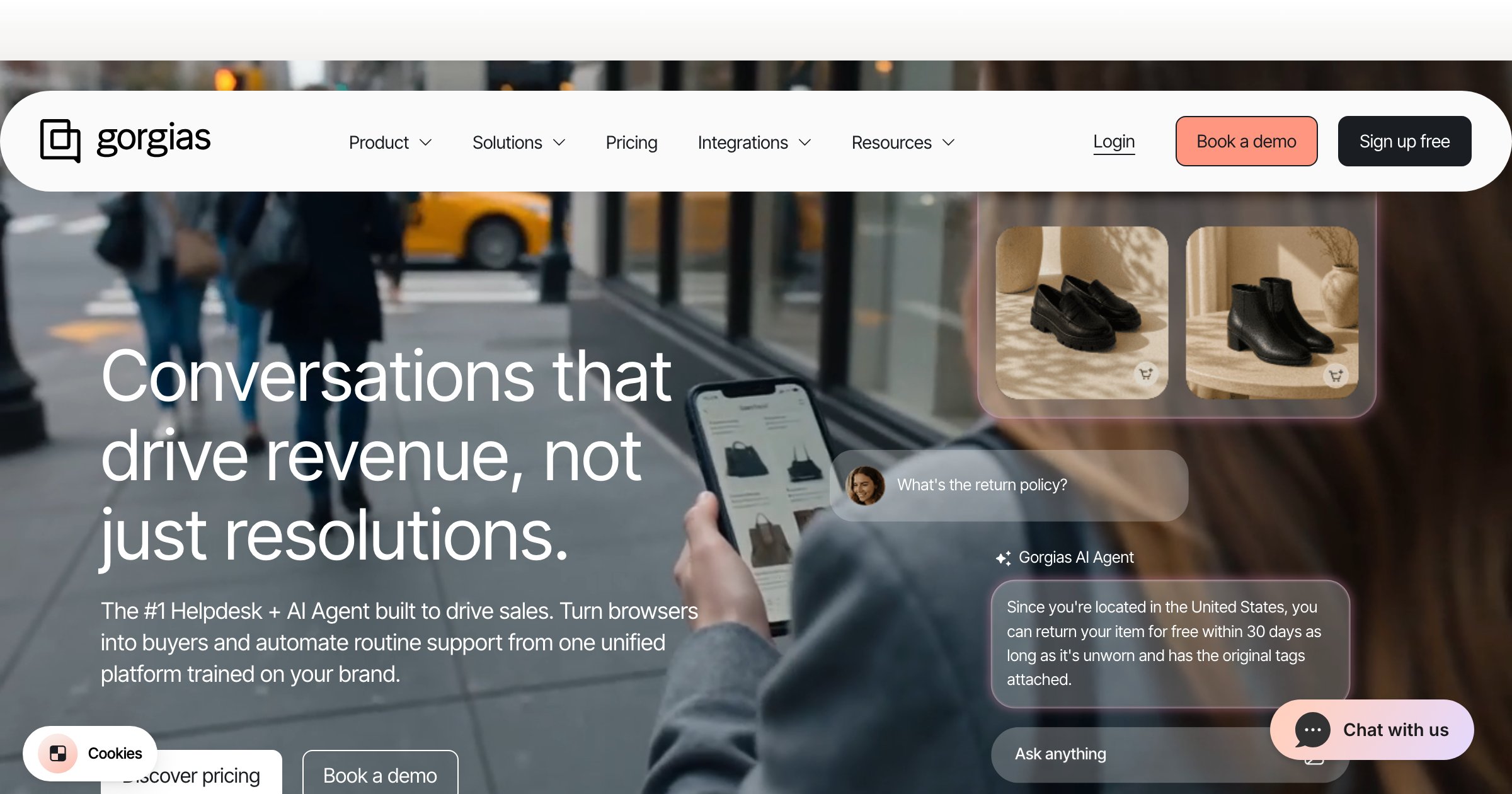
Gorgias is the helpdesk built specifically for Shopify, Magento and BigCommerce stores. Its AI is trained on your order data, so it can answer “where is my order” questions, start returns, and recommend products by pulling live store information rather than guessing. For merchants already deep in the Shopify ecosystem, Gorgias is the most integrated option on the market.
Best for: Shopify and BigCommerce merchants who want a helpdesk that understands their store data out of the box. Pricing: tiered by ticket volume; lower plans suit small stores, higher tiers add automation and multi-store support. Pro tip: connect Gorgias to your store before configuring macros — its order-aware macros are where the time savings actually show up.
2. Zendesk AI
Zendesk AI is the general-purpose giant, and its AI layer now handles intelligent ticket routing, macro suggestions, sentiment detection and answer bot. It’s less ecommerce-specific than Gorgias, but far deeper as a platform — advanced reporting, hundreds of integrations, and a mature agent workspace that scales to large support teams.
Best for: growing ecommerce operations that need a powerful, general helpdesk with room to scale beyond support. Pricing: per-seat pricing starting around the mid-range; Advanced AI features are an add-on on top of the base plan. Pro tip: turn on intelligent triage early — letting AI route by intent and sentiment is where Zendesk’s AI earns its premium.
3. Freshdesk (Freddy AI)
Freshdesk, powered by its Freddy AI assistant, brings auto-suggest replies, ticket summarization and chatbot deflection to a helpdesk known for being affordable and easy to adopt. For small-to-mid ecommerce teams that find Zendesk overkill, Freshdesk hits a practical middle ground.
Best for: budget-conscious small and mid-sized stores that want solid AI assistance without enterprise pricing. Pricing: free tier available; paid plans scale per agent with Freddy features on higher tiers. Pro tip: train Freddy on your past resolved tickets so its reply suggestions match your brand voice.
AI Agents That Layer on Your Helpdesk
Not everyone wants to rip out their helpdesk. These tools sit on top of Zendesk, Gorgias, Intercom, Freshdesk or HubSpot and add a resolution-focused AI agent — often at a fraction of what the helpdesk’s own AI costs.
4. My AskAI
My AskAI plugs into your existing helpdesk (Zendesk, Intercom, Gorgias, Freshdesk or HubSpot) and resolves support tickets at roughly $0.10 per ticket handled. It syncs your help center, trains on past tickets, connects to live order data (including Shopify), and automates tasks like refunds end-to-end. The company reports over 1.5 million tickets resolved and an average AI resolution rate above 75%.
Best for: stores already on Zendesk, Gorgias, Intercom, Freshdesk or HubSpot that want a cheaper, higher-resolution AI agent without changing helpdesks. Pricing: 30-day free trial; Pro from $199/month (1,000 tickets), Scale $499/month (2,000 tickets, $0.10/extra ticket), Enterprise from $999/month. Pro tip: start with internal-note replies (visible only to your team) to build trust, then switch to direct customer replies once accuracy is proven.
5. Botpress
Botpress is an enterprise-grade AI agent platform that takes real actions on tickets — refunds, account updates, order corrections — before escalating to a human with the full conversation history attached. Its defining feature is pricing: no per-seat cost, ever, with AI usage bundled into the conversation allotment. It works on top of your existing helpdesk or as a standalone AI-native helpdesk (Botpress Desk).
Best for: support-heavy operations that have hit a ceiling with basic chatbots and want AI that resolves complex tickets without per-seat licensing. Pricing: Free (100 conversations/month), Plus $150/month, Team $750/month, Enterprise custom — all conversation-based, no per-seat. Pro tip: if you’re comparing total cost against Zendesk or Intercom, Botpress’s no-per-seat model saves the most as your agent headcount grows.
6. Ada
Ada is an AI automation platform focused on brand-safe, no-code customer service agents. It’s used by large ecommerce and consumer brands to automate resolutions across web, chat and social channels, with strong governance over tone and escalation. Ada is built for scale — if you’re handling hundreds of thousands of conversations, that’s its sweet spot.
Best for: established brands with high conversation volume that need a governed, brand-consistent AI agent. Pricing: custom enterprise pricing based on volume and use cases. Pro tip: invest time in Ada’s automation governance — its brand-safety and escalation controls are what justify the enterprise tier.
AI Chatbots & Live Chat for Online Stores
If you don’t need a full helpdesk and just want an AI chatbot on your storefront to answer questions, recommend products and capture leads, this tier is the lighter, faster-to-deploy option.
7. Tidio
Tidio combines AI chatbot, live chat and email in one widget that’s trivial to add to a Shopify, WooCommerce or Wix store. Its AI bot answers FAQs, tracks orders and recommends products 24/7, while live chat kicks in for anything the bot can’t handle. For small stores that want an affordable “always-on” presence, Tidio is the most popular starting point.
Best for: small and independent stores that want a quick-to-deploy AI chatbot plus live chat without a full helpdesk. Pricing: freemium; paid plans add AI capabilities and higher conversation limits. Pro tip: set up the bot to handle order-status and shipping questions first — that’s where Tidio removes the most repetitive work.
8. Heyday by Hootsuite
Heyday by Hootsuite is a conversational AI platform built for retail and ecommerce. It handles product FAQs, appointment booking, order tracking and automated product recommendations across web chat and social messaging — all within one inbox. It suits mid-market retailers with a presence across multiple messaging channels.
Best for: mid-market retailers managing conversations across web chat, WhatsApp, Instagram and Facebook. Pricing: custom plans based on channels and volume. Pro tip: use Heyday’s product-catalog integration so the bot can recommend real inventory rather than generic links.
Cross-Border & Multilingual Customer Service
Cross-border ecommerce adds a layer of complexity: multiple languages, time zones, and marketplaces. These tools are built for that reality.
9. QuickCEP
QuickCEP is a customer experience platform designed for cross-border ecommerce, combining AI chatbot, live chat, marketing automation and customer data in one. It supports multilingual conversations and is aimed at sellers operating across multiple regions and platforms who need to centralize customer interactions.
Best for: cross-border sellers managing multilingual support across regions and channels. Pricing: tiered plans; check the official site for details. Pro tip: centralize all your regional channels into QuickCEP so the AI has one consistent knowledge base across markets.
10. Sobot
Sobot is an intelligent customer service platform (originally from the Chinese market) offering AI chatbot, omnichannel helpdesk, voice and intelligent voice bot. It’s used by brands operating in cross-border and Asia-Pacific markets that need deep multilingual support and a unified agent workspace.
Best for: brands with cross-border or Asia-Pacific operations needing omnichannel plus multilingual AI. Pricing: custom plans based on modules and scale. Pro tip: leverage Sobot’s intelligent voice bot if phone support is part of your cross-border operation — it handles multilingual IVR well.
11. Re:amaze
Re:amaze is a helpdesk and live chat platform built for online stores, integrating email, social media, SMS and live chat into a shared inbox with automation and AI-assisted responses. It’s lighter than a full enterprise helpdesk but more store-aware than a generic one, making it a practical pick for independent and DTC brands.
Best for: independent and DTC brands wanting a store-aware shared inbox with built-in automation. Pricing: tiered per staff user; check the official site for current plans. Pro tip: use Re:amaze’s automated FAQ responses to handle repetitive pre-sale questions before they reach an agent.
How to Choose the Right AI Customer Service Tool
There’s no single best tool — only the best fit for your stack, scale and budget. Here’s how the options compare across the decisions that matter:
| If you are… | Start with |
|---|---|
| On Shopify and want order-aware support | Gorgias |
| Already on Zendesk/Intercom and want better AI for less | My AskAI |
| Hitting a ceiling with basic chatbots, want AI that resolves | Botpress |
| A small store wanting a quick chatbot + live chat | Tidio |
| A large brand with high volume and brand-safety needs | Ada |
| Selling cross-border with multilingual support | QuickCEP or Sobot |
| An independent store wanting a conversion-focused assistant | Chat123 |
A few principles that cut across all the tools:
- Resolution beats deflection. Prioritize tools that take actions (refunds, order edits) over those that only hand out help articles. My AskAI and Botpress are the strongest here.
- Don’t pay per seat unless you have to. Botpress charges by conversation, not by agent — that changes the math as your team grows.
- Layer before you replace. If you’re already on Zendesk or Gorgias, try adding an AI agent (My AskAI, Ada) before you rip out your helpdesk. The switch cost is often unnecessary.
- Match the tool to your platform. Shopify-first stores get the most from Gorgias and Tidio; cross-border sellers benefit from QuickCEP and Sobot’s multilingual depth.
The Bottom Line
AI customer service in 2026 is no longer about a chatbot that says “let me connect you to an agent.” It’s about agents that close the loop on real tickets — at $0.10 each, with no per-seat tax, across every channel and language your store sells through. Pick the tier that matches where you are today, and remember that the best tool is the one your team will actually let handle the hard tickets.
Explore the full set of customer service AI tools on FlowCay and compare detailed profiles before you commit.