
15 Best AI Tools for Amazon Sellers in 2026
Selling on Amazon in 2026 is a different game than it was even two years ago. The marketplace is more crowded, advertising costs keep climbing, and the sellers winning the Buy Box are the ones who let AI handle the repetitive work — product research, listing copy, image editing, keyword tracking — so they can focus on strategy and sourcing.
The good news is that the AI tooling built specifically for Amazon sellers has matured fast. You no longer have to stitch together ten generic tools and hope they work. There are now dedicated platforms for every stage of the Amazon workflow, from finding a profitable product to squeezing more margin out of your existing catalog.
This guide walks through the 15 best AI tools for Amazon sellers in 2026, grouped by the job each one does. Every tool below is listed on FlowCay, so you can click through to a detailed profile before you commit.
Product Research & Market Intelligence
Product research is where AI pays off fastest. Instead of manually scrolling Best Seller Rankings, these tools surface demand, competition and margin signals across millions of ASINs.
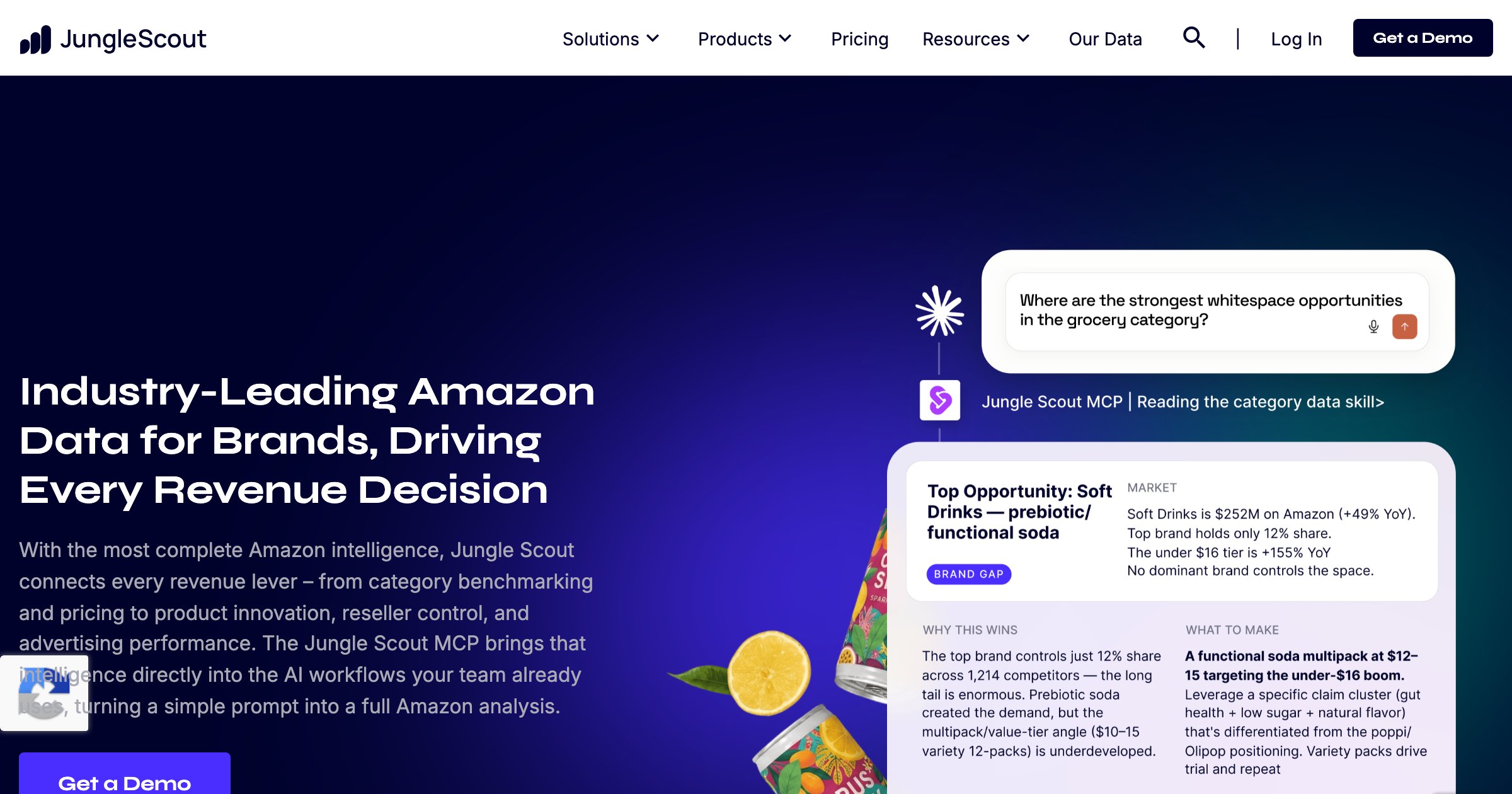
1. Jungle Scout
Jungle Scout is the longest-established Amazon product research and market intelligence platform. Its database lets you filter millions of products by category, sales, revenue and reviews to spot opportunities before they get crowded. The AI-assisted features now help you assess demand trends and estimate sales velocity with reasonable accuracy.
Best for: new and experienced sellers who want a trusted, all-in-one research foundation. Pricing: tiered monthly plans from a low starter tier up to enterprise; annual billing earns a meaningful discount. Limitations: the estimates are statistical — always cross-check against your own data once you start a launch. Pro tip: combine Jungle Scout’s product database with its Opportunity Score to shortlist, then validate top picks with Helium 10’s Cerebro for keyword demand.
2. Helium 10
Helium 10 is an all-in-one SaaS toolkit for Amazon, Walmart and TikTok Shop sellers. It combines the Black Box product database, Cerebro reverse-ASIN keyword lookup, and a full listing builder. If Jungle Scout is the calm veteran, Helium 10 is the power-user suite — deeper data, more filters, steeper learning curve.
Best for: data-driven sellers running multiple SKUs who need granular keyword and competitor analysis. Pricing: a usable free tier, mid-tier monthly plans around the cost of a Netflix subscription, and a high-end plan for agencies. Limitations: the surface area is large — plan a week to onboard before you judge the value. Pro tip: start with Black Box + Cerebro, the two tools that pay for the whole subscription.
3. SellerSprite
SellerSprite is a product research tool with particularly strong coverage of cross-border sellers operating across Amazon global marketplaces. It’s a practical pick if you’re sourcing from Asia and selling into the US or EU, because it surfaces market data tuned to that workflow.
Best for: cross-border sellers who want research data aligned with an Asia-based supply chain. Pro tip: use SellerSprite alongside the open MCP connector so your agent can query the data conversationally.
4. FindNiche
FindNiche started as a dropshipping toolkit but has grown into a broader AI-driven niche discovery platform spanning multiple marketplaces. It’s useful when you want to validate a product idea across Amazon, Shopify and AliExpress in one pass rather than researching each in isolation.
Best for: sellers testing products across more than one channel.
5. AMZScout
AMZScout is a product research and market analysis suite with a product database, keyword research, competitor tracking and listing optimization. It’s a solid, slightly more affordable alternative if you don’t need the full depth of Jungle Scout or Helium 10.
Best for: budget-conscious new sellers.
Listing Optimization & Copywriting
A great product with a weak listing loses to a mediocre product with a sharp listing. AI listing tools write titles, bullets and descriptions that cover the keywords buyers actually search.
6. CopyMonkey
CopyMonkey generates and optimizes Amazon listing copy — titles, bullet points and descriptions — while keeping keyword coverage in check. If you’re launching several ASINs at once, it turns a multi-hour copywriting grind into a few minutes per listing.
Best for: sellers launching or refreshing multiple listings. Pro tip: always do a final human pass — AI gets the keyword coverage right but sometimes misses brand-voice nuances. Common mistake: publishing AI copy without checking against Amazon’s style guide; character limits and prohibited claims still apply.
7. Amazon Seller Agent Skills
Amazon Seller Agent Skills is an open-source collection of AI Agent skills for Amazon sellers covering product research, feature comparison and listing drafts. If you’re already building workflows on Claude or another agent framework, these skills drop straight in and let an agent handle research tasks for you.
Best for: technical sellers experimenting with AI agents.
Price & Profit Tracking
Margin is where Amazon businesses actually make money. These tools track the numbers that decide whether a SKU is worth scaling or killing.
8. Keepa
Keepa is the price and inventory history tracker every Amazon seller eventually needs. It gives you ASIN-level time series for price, Buy Box, BSR and review count — essential for spotting whether a “trending” product is actually trending or just had one viral week.
Best for: every Amazon seller, full stop. Pricing: a one-time license fee per marketplace — unusually fair for the depth of data. Pro tip: install Keepa once and never uninstall; the historical view of any new ASIN you consider is the single biggest risk-reduction tool in your stack.
9. ZonGuru
ZonGuru is an AI toolkit for Amazon sellers that covers product research, keyword tracking and — critically — profit dashboards that pull in your real Amazon fees so your margin numbers are honest rather than aspirational.
Best for: sellers who want research and profit tracking under one roof.
10. Prisync
Prisync is a competitor price tracking and dynamic pricing SaaS. While it spans ecommerce broadly, Amazon sellers use it to monitor how competitors reprice and to keep their own pricing competitive without manual checks.
Best for: sellers competing on price in crowded categories.
AI Agents & MCP Integrations
The newest category — and the one that will define 2026 — is AI agents that talk directly to Amazon data via MCP (Model Context Protocol). Instead of exporting CSVs, you ask a question in plain English and the agent pulls the answer.
11. Helium 10 MCP
Helium 10 MCP ships 30+ Amazon data tools as an MCP connector, so Claude (or any MCP-compatible agent) can query Helium 10’s keyword and product data directly. It’s the fastest way to go from “I wonder which keywords this ASIN ranks for” to a real answer.
Best for: sellers already living in an AI assistant. Pro tip: start with one or two repeatable questions (e.g. “rank these keywords by search volume for ASIN X”) before building broader workflows.
12. Jungle Scout MCP
Jungle Scout MCP exposes Jungle Scout’s enterprise Amazon intelligence to Cobalt-powered workflows. If your team already standardized on Jungle Scout, this is how you bring that data into your agent stack.
Best for: teams on Jungle Scout enterprise.
13. SellerSprite MCP
SellerSprite MCP connects LLMs and AI agents (Claude, ChatGPT) to SellerSprite’s research data. It’s especially handy for cross-border sellers who want an agent to draft listing copy in multiple languages using real keyword data.
Best for: cross-border sellers running multilingual listings.
14. Amazon Sorftime Research
Amazon Sorftime Research is an Agent Skill that runs listing audits and category/keyword research as part of an agent workflow — useful when you want a repeatable, scheduled review of your catalog’s keyword coverage rather than a one-off check.
Best for: sellers who want automated, recurring listing audits.
Web Scraping & Data Collection
15. Thunderbit
Thunderbit is an AI-powered Chrome extension and web app for scraping and extracting data from any page. Amazon sellers use it to pull competitor listings, review data and supplier pages into structured tables without writing a single line of code.
Best for: sellers who build their own research datasets.
How to Choose the Right Amazon AI Tools
Selection checklist for each category:
- Product research: verifiable sales-velocity data, regular database updates, refund policy for inaccurate estimates.
- Listing: respects Amazon’s character limits, tests keyword coverage against live search results, lets you lock brand-voice terms.
- Profit tracking: pulls real Amazon fees (not retail math), tracks per-SKU margin, alerts on fee changes.
- AI agents: MCP-first tools beat screen-scraping agents — they’ll keep working when Amazon updates its UI.
- Scraping: can structure the output into a sheet, not just dump HTML.
Common Mistakes to Avoid
- Buying all 15 at once. Start with research and listing tools; add profit and agents once you have revenue.
- Trusting estimates blindly. All research tools give ranges. Validate with a small test order before committing inventory.
- Ignoring compliance. AI listing copy still needs to respect Amazon’s style guide; an account suspension isn’t worth the time saved.
- Skipping profit tracking. Top-line revenue growth with shrinking margin is how sellers quietly go out of business.
How to Build Your Amazon AI Stack
A sensible stack for most sellers looks like this:
- One product research platform — Jungle Scout or Helium 10, picked based on how data-hungry you are.
- One listing tool — CopyMonkey, or the Agent Skills if you’re technical.
- Keepa — non-negotiable for price history.
- One profit tracker — ZonGuru if you want research bundled in, Prisync if pricing is your main battle.
- One MCP/agent integration — only once you’re comfortable letting an AI assistant do the querying.
Start with research and listing tools, because they directly affect what you sell and how well it converts. Layer in profit tracking once you have revenue to track. Add agents last, once you know which questions you keep asking over and over.
FAQ
What’s the single best AI tool for a brand-new Amazon seller? Start with Helium 10’s free tier or Jungle Scout’s basic plan. Both cover the product research you’d otherwise do manually and give you keyword data for your first listing.
Do I need both Helium 10 and Jungle Scout? Most sellers don’t. Pick one based on whether you value a calmer interface (Jungle Scout) or a deeper toolkit (Helium 10). If you’re an agency or running multiple brands, the cost of both can be justified.
Are MCP agents ready for production? For research and listing drafts, yes. For actions that change your account (e.g. editing live listings, adjusting bids), keep a human-in-the-loop review until the agent has earned your trust on your data.
How much should I spend on Amazon AI tools per month? For a single new seller: $50–150 is plenty. For a scaling brand with 10+ SKUs: $300–800 unlocks the full workflow. Above that, you’re paying for features you may not use yet.
The Bottom Line
The Amazon sellers pulling ahead in 2026 aren’t working harder — they’re letting AI tools absorb the research, copywriting and tracking work that used to eat their evenings. Pick one tool from each category above, and you’ll have a modern, AI-assisted workflow without overspending on software.
Want to explore more ecommerce AI tools beyond Amazon? Browse the full FlowCay directory to find tools for Shopify, TikTok Shop, product photography, marketing automation and more.