
AI Tools for Cross-Border Ecommerce: A 2026 Guide
Cross-border ecommerce — selling into markets outside your own country — is where AI tools deliver their biggest leverage. A domestic seller deals with one language, one platform and one logistics network. A cross-border seller deals with many of each, simultaneously, and the manual workload used to be the single biggest thing stopping good brands from going global.
In 2026, AI has collapsed that workload. Store builders, ERPs, AI agents and composable Skills now handle the multilingual listings, multi-marketplace operations and logistics complexity that used to require large teams. This guide covers the AI tools that matter most for cross-border sellers.
What Makes Cross-Border Different
Cross-border ecommerce stacks four hard problems on top of normal ecommerce:
- Language — listings, ads and support in the buyer’s language.
- Marketplaces — Amazon, Shopify, TikTok Shop, Ozon, Mercadolibre, each with its own rules.
- Logistics — overseas warehouses, customs, multi-region inventory.
- Operations — currency, pricing, compliance across regions.
The tools below each attack one or more of these.
Store Building & Operations
1. Shoplazza
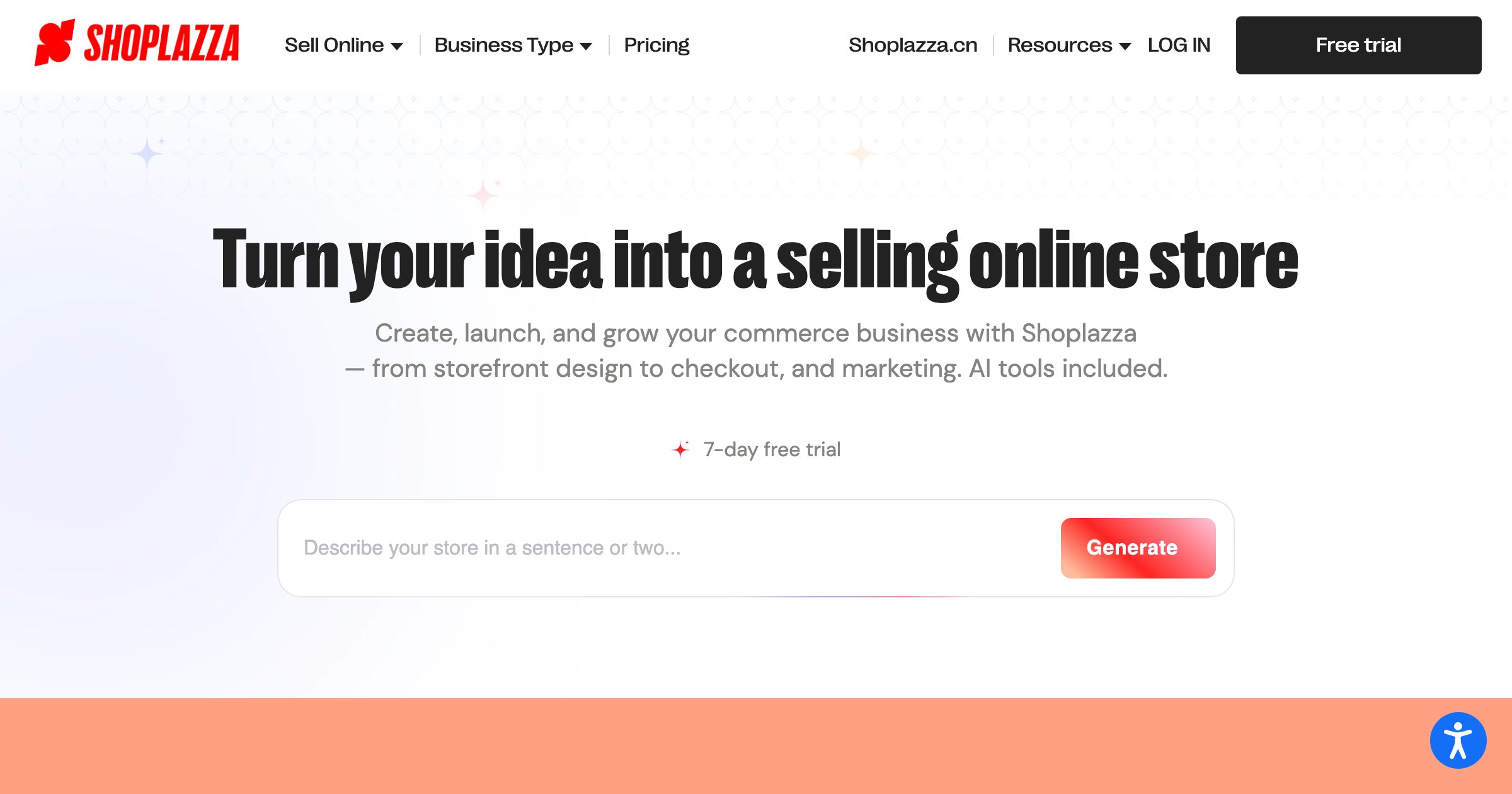
Shoplazza is an ecommerce website builder built specifically for cross-border sellers, with multilingual storefronts and tooling tuned for international operations. It’s a strong pick if you want a hosted store aimed at cross-border from day one, rather than adapting a domestic-first platform.
Best for: cross-border sellers who want a multilingual storefront out of the box. Pro tip: start with one target market, get the store fully translated and tested, then add additional markets.
ERP & Logistics
2. Dianxiaomi
Dianxiaomi is a cross-border ERP used by over 1.8 million sellers. It pulls listings, orders and inventory across marketplaces into one system, which is the unglamorous foundation that everything else in cross-border depends on.
Best for: cross-border sellers operating on multiple marketplaces simultaneously. Pricing: tiered plans that scale with order volume and number of connected platforms. Pro tip: connect all your channels to Dianxiaomi first, then automate the workflows that used to be manual. Don’t try to run it as just an order manager.
3. Eccang
Eccang is a cross-border ERP focused on logistics management. If your pain point is warehouse routing, shipping cost optimization and tracking across regions rather than listing management, Eccang is the layer that solves it.
Best for: sellers whose bottleneck is logistics, not listings.
AI Agents for Cross-Border
4. clawEC Cross-border Agents
clawEC is an open-source set of cross-border ecommerce AI agents for multi-platform product research and operations. If you’d rather run your own agents than pay for a hosted platform, this is the starting point.
Best for: technical sellers who want self-hosted agents.
5. LinkFox AI
LinkFox AI is an AI Agent OS for cross-border e-commerce sellers — a hosted environment for running agents across the cross-border workflow. It’s geared toward sellers who want agent capabilities without building the infrastructure themselves.
Best for: sellers who want agent power without the DevOps.
AI Agent Skills for Cross-Border
Skills are composable AI capabilities that run inside an agent like Claude. For cross-border sellers building agent workflows, these are the building blocks.
6. Awesome Amazon EC Skills
Awesome Amazon EC Skills is a curated collection of Claude and AI Agent Skills for Amazon cross-border sellers. If Amazon is your main channel, this is the most complete starting skill pack.
Best for: cross-border Amazon sellers using Claude.
7. Ozon Profit Skills
Ozon Profit Skills is a set of Claude Code skills for cross-border automation, including profit analysis for the Ozon marketplace. If you sell into Russia/CIS via Ozon, this fills a niche most other tools ignore entirely.
Best for: sellers on Ozon and CIS marketplaces.
8. LytSkill
LytSkill is a Skill focused on cross-border e-commerce business analysis and operations. It’s useful when you want an agent to look at your numbers and operations and surface what needs attention.
Best for: sellers who want agent-driven business analysis.
Visual Content for Cross-Border
Cross-border sellers produce more images than anyone, because each marketplace and region wants its own scene and style.
9. PixPix
PixPix is an AI visual creation platform built for cross-border e-commerce, with batch workflows tuned for sellers managing visuals across many SKUs and markets.
Best for: cross-border sellers with high-volume image needs.
How to Choose the Right Cross-Border AI Tools
Selection criteria by problem:
- Language first → start with a localization and listing tool, plus multilingual support (see the AI Localization category).
- Marketplaces first → start with Dianxiaomi or Eccang to get operations under control.
- Logistics first → Eccang.
- Amazon-specific → pair the Amazon AI tools with the Awesome Amazon EC Skills.
Most cross-border sellers end up with three layers: a foundation (ERP + store), a marketplace-specific toolset (Amazon or Shopify tools), and an automation layer (agents and Skills). Build the foundation first — agents on top of a messy operation just automate the mess.
Common Mistakes to Avoid
- Adding markets before operations are clean. Expanding to a new country on top of broken inventory management is how sellers lose money fast.
- Translating listings only, not ads and support. Buyers in every market expect the full experience in their language.
- Ignoring compliance. Tax rules, customs documentation and product regulations differ per country. AI helps with the workload but doesn’t replace legal review.
- Picking tools per market in isolation. The point of cross-border is operating leverage across markets — choose tools that connect, not tools that silo.
Building a Cross-Border AI Stack by Scale
| Scale | Stack |
|---|---|
| Starting cross-border ($0–10K/mo) | Shoplazza + Dianxiaomi (or a lightweight ERP) + Chat123 + one marketplace-specific AI tool |
| Growing cross-border ($10K–100K/mo) | Shoplazza or Shopify + Dianxiaomi + clawEC or LinkFox + Amazon EC Skills + multilingual support |
| Established cross-border ($100K+/mo) | Full ERP + multiple marketplace integrations + agent OS + localization + analytics + custom Skills |
How to Roll Out a New Market
A practical sequence when expanding into a new country:
- Translate listings first with AI (save human translation for high-value SKUs).
- Set up localized ads using the same product images with regional copy.
- Configure multilingual support before you launch, not after the first complaint.
- Run the new market on your existing ERP to avoid data fragmentation.
- Add Skills for that market’s specifics (e.g. Ozon Profit Skills for Russia) once you’ve validated demand.
- Localize product images with cultural context, not just language.
FAQ
Do I need a separate ERP for each marketplace? No — the whole point of an ERP like Dianxiaomi is to connect all your marketplaces into one system. Run one ERP and connect Amazon, Shopify, TikTok Shop, etc. to it.
How do I handle customer support across multiple languages? Either staff multilingual support agents, or use an AI support tool with multilingual capability (QuickCEP, Gorgias with translation). AI support handles 70-80% of common questions; the rest gets routed to humans.
What about taxes and compliance across markets? ERP tools help with the operational workload (VAT calculation, customs paperwork), but consult a cross-border tax professional for legal setup. AI tools won’t replace legal advice on tax structure.
Is Shoplazza better than Shopify for cross-border? For pure cross-border from day one, Shoplazza is opinionated for that workflow. For a global brand that also has domestic presence, Shopify’s ecosystem and integrations may be worth the extra configuration work.
The Bottom Line
Cross-border ecommerce used to be a game only large teams could play. In 2026, AI tools have lowered the operational cost enough that a focused seller can run a serious multi-market business with a small team — provided they pick the right tools for their specific bottleneck.
For the full landscape of ecommerce AI tools across every category, browse the FlowCay directory or read the complete ecommerce AI tools guide.